Ten Months of Solo AI Coding Revealed These Five Structural Failures
AI coding promises 10×. The real story: 10× tactical throughput, roughly 1× strategic judgment. A 5-layer governance framework for what actually breaks when you push AI coding past a single repo and a single sprint — and the order that matters for adopting it.
For eight months I ran a pattern I didn’t notice until I counted it. One service boundary generated eight separate AI-assisted fixes over seven days. Each fix was reasonable. Each one took under ten minutes — this was the era when AI coding still meant GPT paired with a VS Code plugin. And somewhere in a parked branch sat the architectural migration that would have eliminated all eight — requiring three hours of design work, a conversation with another team, and the courage to absorb deployment risk.
The AI never suggested the migration. It never blocked the tactical fix to ask “is this the right move?” It just helped me go faster in the direction I was already pointing.
That pattern — repeated across four repos and ten months — is the real story of what AI coding does at scale. Not 10× productivity. Something more specific and less flattering: 10× tactical throughput, roughly 1× strategic judgment. The asymmetry is where everything breaks.
Five structural failures
These aren’t bugs in Claude Code or Codex. They’re structural consequences of the speed differential between “AI can write a fix in minutes” and “a human needs hours to decide whether the fix is the right thing to do.”
Failure 1 — Strategic drift via tactical acceleration
When tactical fixes take five minutes and architectural migrations take half a day, systems accumulate tactical debt in direct proportion to AI velocity. AI tools today don’t accumulate cross-session pattern awareness — they don’t surface “this is your eighth fix in this file this week.” They minimize friction for whatever you ask. The parked architectural solution never gets a forcing function.
Failure 2 — Architectural amnesia across sessions
Code I extracted to a separate service in one session re-emerged inside the original repo two weeks later. Neither session had any awareness of prior architectural intent. Both moves looked locally correct. The decision — “we extracted this” — had no durable home between sessions.
Failure 3 — Cross-repo contracts invisible to AI
When service A sends a payload service B doesn’t recognize, AI can fix B locally in minutes. What it can’t see — because it’s never simultaneously holding both repos — is whether the real fix belongs on the caller side, whether the change needs a coordinated rollout, whether three other consumers will silently break. Every multi-service bug I hit had this shape. The AI fixed locally; the coordination cost fell entirely on me.
Failure 4 — GitHub gates designed for human pace
Branch protection, required reviews, CODEOWNERS — all designed assuming one PR per developer per day. At AI velocity (50–100 PRs/week is realistic), gates have two failure modes: they get skipped because friction multiplies 100× while value is felt once, or they become self-checklists where you are the only CODEOWNER, the required reviewer, and the sign-off owner. Both modes turn audit trails into theater.
Failure 5 — Review at AI velocity is a math problem
100 PRs/week, one human reviewer. The math is uncomfortable before you even try. The natural responses — skip review, self-approve, slow down writing — each carry failure modes worth naming.
A 5-layer framework
Each failure maps to a governance layer. The model below answers one question per layer and names the AI-specific failure mode that layer has to absorb.
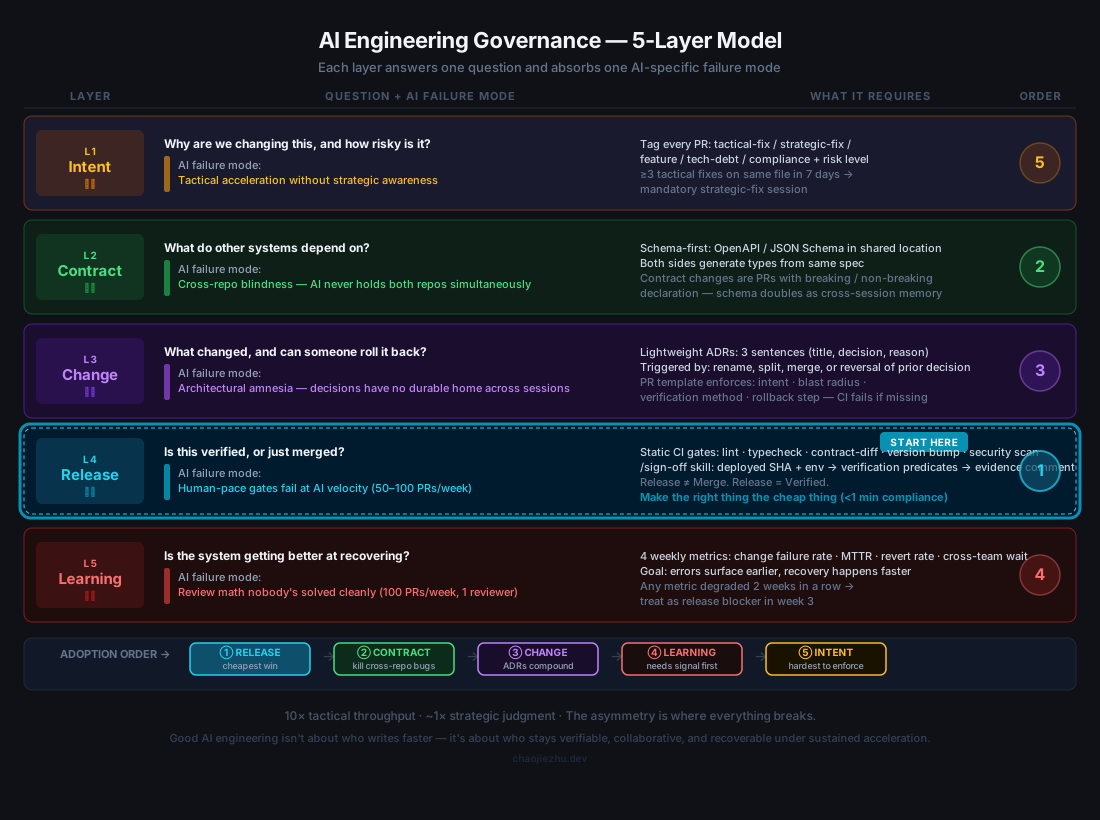
| Layer | Question | AI failure mode |
|---|---|---|
| Intent | Why are we changing this, and how risky is it? | Tactical acceleration without strategic awareness |
| Contract | What do other systems depend on? | Cross-repo blindness |
| Change | What changed, and can someone roll it back? | Architectural amnesia |
| Release | Is this verified, or just merged? | Human-pace gates at AI velocity |
| Learning | Is the system getting better at recovering? | Review math nobody’s solved cleanly |
Brief version of what each layer actually requires:
Intent
Every PR carries an explicit tag (tactical-fix, strategic-fix, feature, tech-debt, compliance) and a risk level. Run a weekly query: ≥3 tactical-fix PRs on the same file in 7 days triggers a mandatory strategic-fix session before more tactical work in that area.
Contract
Cross-service interactions are schema-first (OpenAPI / JSON Schema in a shared location both sides read). Both sides generate types from the same spec. Contract changes are PRs, with an explicit breaking / non-breaking declaration. The schema also acts as the cross-session memory AI tools currently don’t natively provide.
Change
Lightweight ADRs — three sentences each (title, decision, reason) — triggered by any rename, split, merge of service boundaries, or reversal of a prior decision. PR template enforces four required fields: intent, blast radius, verification method, rollback step. CI fails if any are missing.
Release
Shift from human-in-the-loop gates (don’t scale) to static CI gates (do): lint, typecheck, contract-diff guard, version-bump enforcement, security scan. Add a /sign-off skill that takes a deployed SHA + env, runs verification predicates, and posts the evidence comment in under 30 seconds. Any compliance ceremony that takes materially more than a minute will lose to code velocity — make the right thing the cheap thing.
Learning
Four metrics reviewed weekly — change failure rate, mean time to recovery (MTTR), revert rate, cross-team blocking time. The goal isn’t fewer errors; it’s errors surface earlier and recovery happens faster. When any metric degrades two weeks in a row, treat it as a release blocker in week three.
The order that matters
Don’t implement all five at once. The sequence that actually works — based on what delivers value fastest without burning out on process:
| Order | Layer | Why first |
|---|---|---|
| 1 | Release | Cheapest win, biggest audit-trail improvement |
| 2 | Contract | Eliminates the largest class of recurring cross-repo bugs |
| 3 | Change | ADRs compound over time; the earlier you start, the more they pay |
| 4 | Learning | Metrics only have signal once the other layers are running |
| 5 | Intent | Hardest to enforce; only works once the team has internalized the others |
Starting with Intent — “tag every PR before you do anything else” — is the fastest path to abandoning the framework. You burn out on process before any of it produces value.
Five principles worth internalizing
- Good AI engineering isn’t about who writes faster — it’s about who stays verifiable, collaborative, and recoverable under sustained acceleration.
- Release ≠ Merge. Release = Verified.
- Cross-team coordination is contract coordination, not verbal coordination.
- A compliance ceremony that doesn’t fit in roughly a minute will lose to code velocity. Make the right thing the cheap thing.
- AI multiplies tactical throughput. Strategic judgment still has to be staffed. The first hire on top of an AI-augmented setup probably shouldn’t be a junior implementer.
Epistemic note
Everything here comes from one context: ten months, solo, 4–5 production repos. The tool stack itself evolved across that period — starting with Cursor, then through the era of GPT paired with VS Code plugins, then a full switch to Claude Code, and finally Claude Code alongside Codex. The failure modes appeared consistent across all of them: the structural argument doesn’t depend on which tool. Whether the patterns generalize beyond solo work is a working hypothesis, not a finding. The acceptance criteria embedded in each layer above are starting points — tune them to your team before you own them.
The claims about what AI tools “don’t do” are observations about current tool defaults, as of mid-2026. New memory layers, MCP integrations, and cross-repo context windows are emerging and may close some of the gaps described here.
What I’m more confident about: the teams and individuals who do well in the next few years are the ones who recognize the asymmetry before they’re buried in it. The failure modes here aren’t the AI’s fault — they look like consequences of asymmetric speed-up landing on organizational processes designed for human pace. Those processes either get rebuilt, or get silently bypassed.
The rebuild is the interesting part.